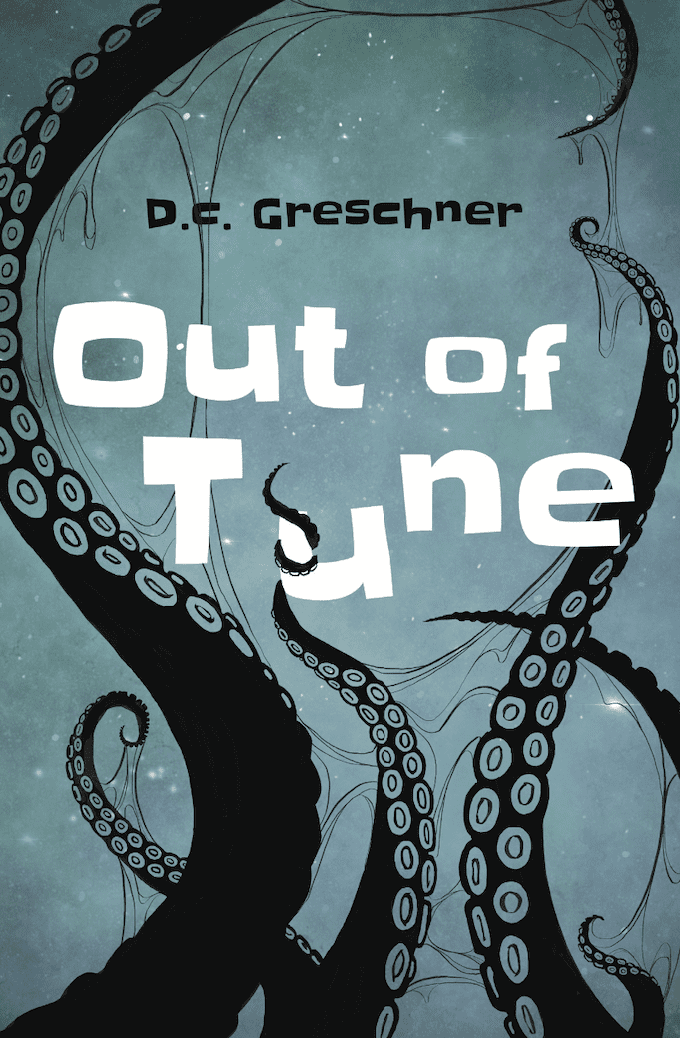

Out of Tune
I could argue it started in early childhood, as I always had the tendency to make up, not only stories, but also games and songs. My earliest recorded writing was a very short story about a kitten playing with a “bool” of yarn that I typed on my mom’s old school typewriter when I was maybe 5 or 6 years old. Most of my creative work in later childhood and early adulthood came in the form of songwriting. In my twenties, I started a folk/ bluegrass band called Windy Bridges, which performed several of my originals (RIP Windy Bridges).
My journey to actually write a full-length novel began in 2016 when I was teaching English in China. I had moved there with a partner, and we broke up halfway through our year-long teaching contract. Afterwards, I had almost no one to talk to, due to the fact that I am not fluent in Mandarin and was living in a smaller city where not many people spoke English. So I suppose I started writing Out of Tune as a way to kill the boredom and avoid my ex (did I mention we still had to live together after breaking up?). At the time, I had no idea whether or not the story would ever see the light of day.
Honestly, I’m not so sure there is much of a difference between satire and reality these days. I just took my observations of real-world issues (mainly the politics of climate change vs. capitalism), applied them to a new setting, tossed in a few aliens, and voila! I may have exaggerated some aspects slightly.
As a teacher, I have become quite good at breaking down complex concepts into simple steps that are easier for students to understand (we call this “scaffolding” in the profession). This skill is transferable to writing, especially the world building aspects of science fiction. For example, I wanted to ensure that the concept of universal detuning included some (remotely) plausible scientific ideas, but was described in such a way that the average non-scientist could understand. Visual aids are also helpful teaching tools, which inspired me to include the phylogenetic tree of life and the life cycle diagram.
Never feel bad about promoting yourself! You could write the greatest book ever written, but convincing people to read it is another beast. Marketing is a never ending job. Try to get as many ARC reviews as you can. Use social media and in-person events to network with other authors and reader communities. Diversity your sales methods. If you just put your book up on Amazon and expect a bunch of randos to discover it, you will be sorely disappointed. I have sold way more books via in-person events like markets and fancons. Even if you are the stereotypical brooding introvert of an author, you have to bite the bullet and get your work out into the world. Last, but not least, beware of scams!