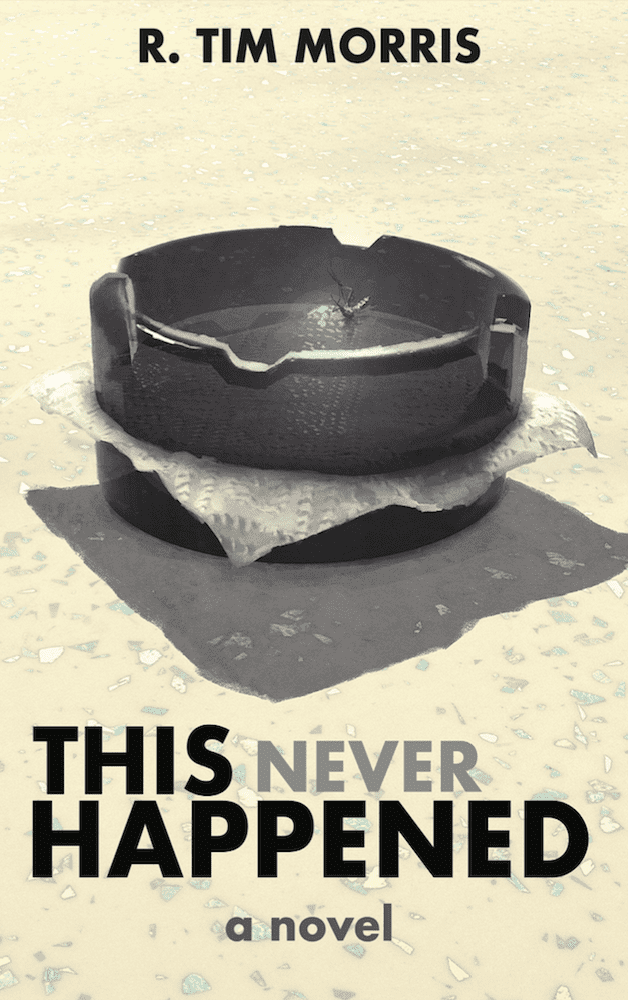

This Never Happened
I’ve always had a desire to create and explore where my imagination takes me. It really started with reading comic books as a kid (my favourites were Iron Man, the X-Men, and Spider-Man), and playing RPG’s with friends. My talent was drawing, which led to me creating my own comics, but I never thought that the writing of these books was my strong suit. In fact, I’d never had much interest in writing—much less reading—novels, but that changed when I was living on my own in Vancouver, working in the animation industry and eventually feeling like drawing wasn’t the proper medium for expressing the things I really wanted to. I dabbled in writing screenplays at first before deciding to challenge myself with the idea of writing a novel. I presumed it would be something I’d never actually finish, and even if I did, it would be a box to check, something to have on my shelf, and then I’d move on to the next thing. But finishing a novel was an addictive feeling, and here I am, twenty years later with six full-length novels, and handfuls of published short stories.
Even when I started writing this book in 2012, I don’t think mental health occupied our thoughts as much as it does now. Still, the book took some wildly different turns from its conception to its completion, and required me to research many different topics, some darker than others. The main theme in the book is this feeling of not belonging, something that most people have experienced at some point in their lives. I tried to take that idea and make it more than a feeling for my main character. His depression, self-harm, and prescription medications are all side effects of his circumstances, some of which I could relate to personally (which, though hard to put on the page, can make it better writing ammunition). The loss of his mother and girlfriend, as well as his father’s sickness and the distance between them both, also fuels these themes. Once I found the main threads in both characters and in plot, it was a much easier way to tie these themes in.
It wasn’t intended to be that way! Originally, This Never Happened was written in first-person, but there was this almost-too-personal feeling to it, if that makes sense. There’s something about third-person that created too much distance for me, so I knew that wasn’t going to be the right way to go for this story either. A few years earlier, I’d read Bright Lights, Big City by Jay McInerney, and remembered how McInerney’s use of second-person POV really created this weird sense of making the reader feel like the subject of the novel. While that wasn’t going to be exactly what I was looking for either, I knew I was on the right track. So I re-wrote the entire book in second-person, crossing my fingers that it would pay off. There’s a twist at the end of This Never Happened that takes the second-person POV the reader has gotten used to at this point, and has it all make sense for what’s really going on. Readers have generally given amazing feedback on the book, and it’s the ending that’s really blown most away, so I guess it paid off!
That’s a tough one. I’ve never been an author who’s sought out what’s popular and tried to emulate it, but that’s typically what seems to garner success in this industry. What I try to do is be honest about what it is I’m writing, and I try to make each individual work as different, and as special, as possible. It’s not led to a ton of success (I’m six books in now, and am basically still an unknown), but I’m writing what I enjoy, and I do find a lot of personal success in trying something new every time. I’ve also written lots of types of stories that I’d historically said I’d never dabble in (like YA or Fantasy, or even short stories and poetry). I guess my best advice is to know what your writing is, while still being open to different ways of expressing it. Also, if you’re writing as nothing more than a hobby, that’s totally fine too. And don’t be afraid to take a break—for a week, a month, or even longer. No need to put unnecessary pressure on yourself when what you’re doing is really meant to be fun.