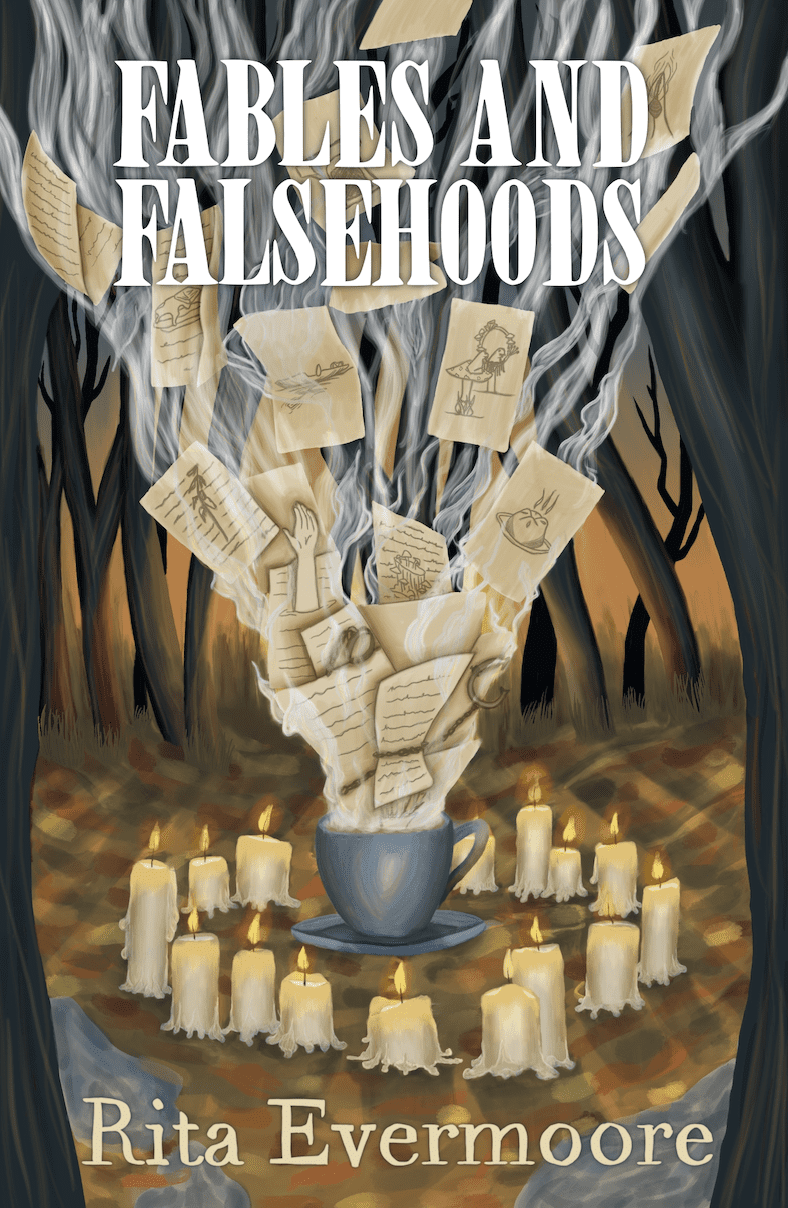

Fables & Falsehoods
Like most authors, my writing journey began with reading. I was a voracious reader as a child, but it didn’t stop with the books themselves. If I read a book I really liked, I would learn as much as I could about the author too. I found the people who spun stories fascinating, and I always wanted to be like them. It is one of the best ways to have a positive impact on society on a larger scale.
As a child, I wrote a lot of beginnings of stories, but never finished them. My siblings and I wrote part of a play together, and any free writing exercise in school inevitably skewed toward fantasy. That is my first love.
As for the beginning of Fables and Falsehoods, that is a different story entirely. I wrote Fables and Falsehoods with self-publishing in mind. I like the idea of having complete control over my story and the nimbleness of marketing that allows me to change anything on a whim. So, I came up with a seasonal cozy fantasy mystery series. This was before Legends and Lattes put cozy fantasy on the map. I remember discussing how the markets for cozy mysteries and fantasy overlap. Some people laughed at me, but a year or two later, Legends and Lattes proved them wrong.
I had written a first draft that went completely wrong. Striking the balance between contemporary and fantasy wasn’t easy. The first draft never got finished because the book took a hard turn into a portal fantasy halfway through, so I abandoned it for a few years. But, it didn’t leave the back of my mind.
When I picked it up again, I gave myself a year and a half to redraft it and get it through all edits, draw the cover and the internal art, and publish it. It was a tall order, but I knew that the timelines would only get tighter. Fables and Falsehoods had a year and a half, but Book 2: Snowdrops and Schemes got six months from the Fables and Falsehoods publication date.
Many of Amber’s experiences are born out of my own. They are, of course, not a one-to-one parallel, but she has a lot of me. The nature of her being a writer is a huge part of this, but another is her neurodivergence. She is stubborn and a bit rash, but logical. Though I lean more stubborn than rash, we share much of the same archetype.
It was fun to explore a story within a story. The book is from Amber’s first-person POV, so the whole book is written in her voice, but the story she writes is still a different voice because it is more internal.
Without giving too much away, the way that Amber interfaces with her writing voice and her own creativity explores aspects of myself in ways that are entertaining. I believe that writing is first and foremost for the author. Of course, we want people to enjoy it, but we have the stories first. We develop as people through our writing, and I like to think that you can see that through Amber.
The toughest part is marketing and getting my book titles out there. It takes a lot of time and is not immediately rewarding. The people who have interacted with my stories have liked them, and I’ve had positive reviews, but it is difficult to get my books in front of people.
I did not expect to have much visibility with book one, but I hope that as I publish more, that will increase my digital footprint and create a snowball effect. I also plan to start running ads after book three is out.
The most rewarding part of this is seeing people enjoy my stories. It means a lot when someone connects with something I’ve written. I put a lot of care into my stories and hope people get even half as much enjoyment out of my stories as I do out of writing them.
I am a fairly new author in this space, as Fables and Falsehoods is my debut, but I have written a decent amount. I wrote a couple of books that I will never publish. They were merely practice. You likely won’t strike gold with your first idea/book, and you will likely have to edit it heavily or put it aside. I took the “put it aside” approach. I wanted to make sure my drafting ability was solid, and I have more ideas than I know what to do with, so it did not feel like a waste. All that to say, it will be a lot of work before you are even close to being ready to publish. Take the time your stories deserve, and don’t be afraid to set a story aside; you may not be ready for it yet.
Another piece of advice is to put yourself out there and apply to things even if they feel like a long shot. That’s how I ended up getting featured here. I think a lot of debut authors are scared of failing, but I like the mentality of “collecting rejections”. To get a rejection is to know that you are trying and putting yourself out there. It reframes your mindset and takes some of the weight off of something that means so much to you. There will be a lot of NOs, but there will be YESs too.
The other thing is research. Learn from those who have done what you want to do. The best thing you can learn from them is their mistakes and what not to do. Take in a large sample size because everyone’s path is different.